

Tree planting at the Evelpidon Grove Tuesday, May 6 – What is planned for the overall restoration of the Grove

On Tuesday, May 6th at 5 pm, the Municipality of Athens is proceeding with tree planting in the Evelpidon Grove and invites residents and friends of the Grove to actively participate in this important effort.
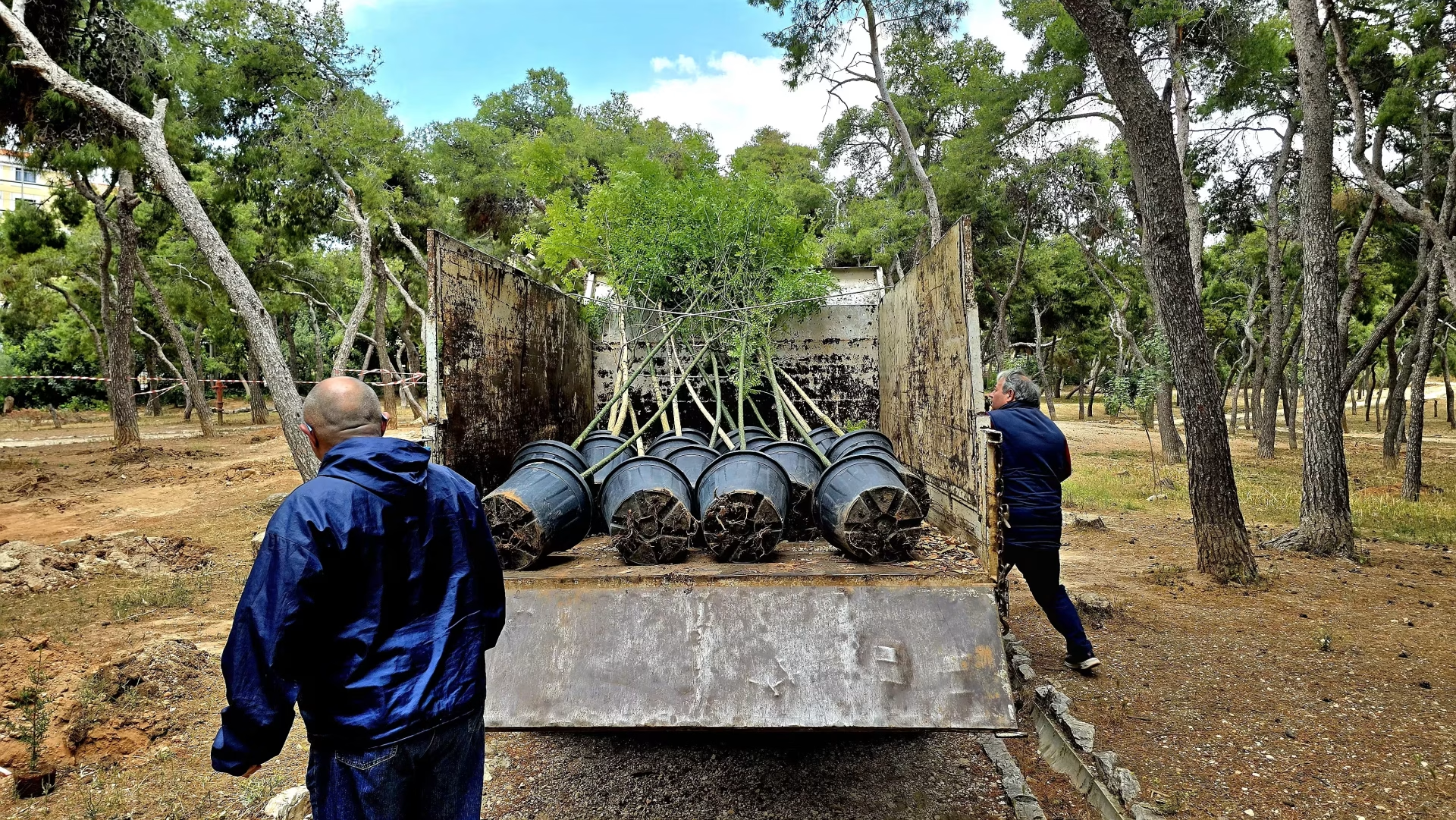
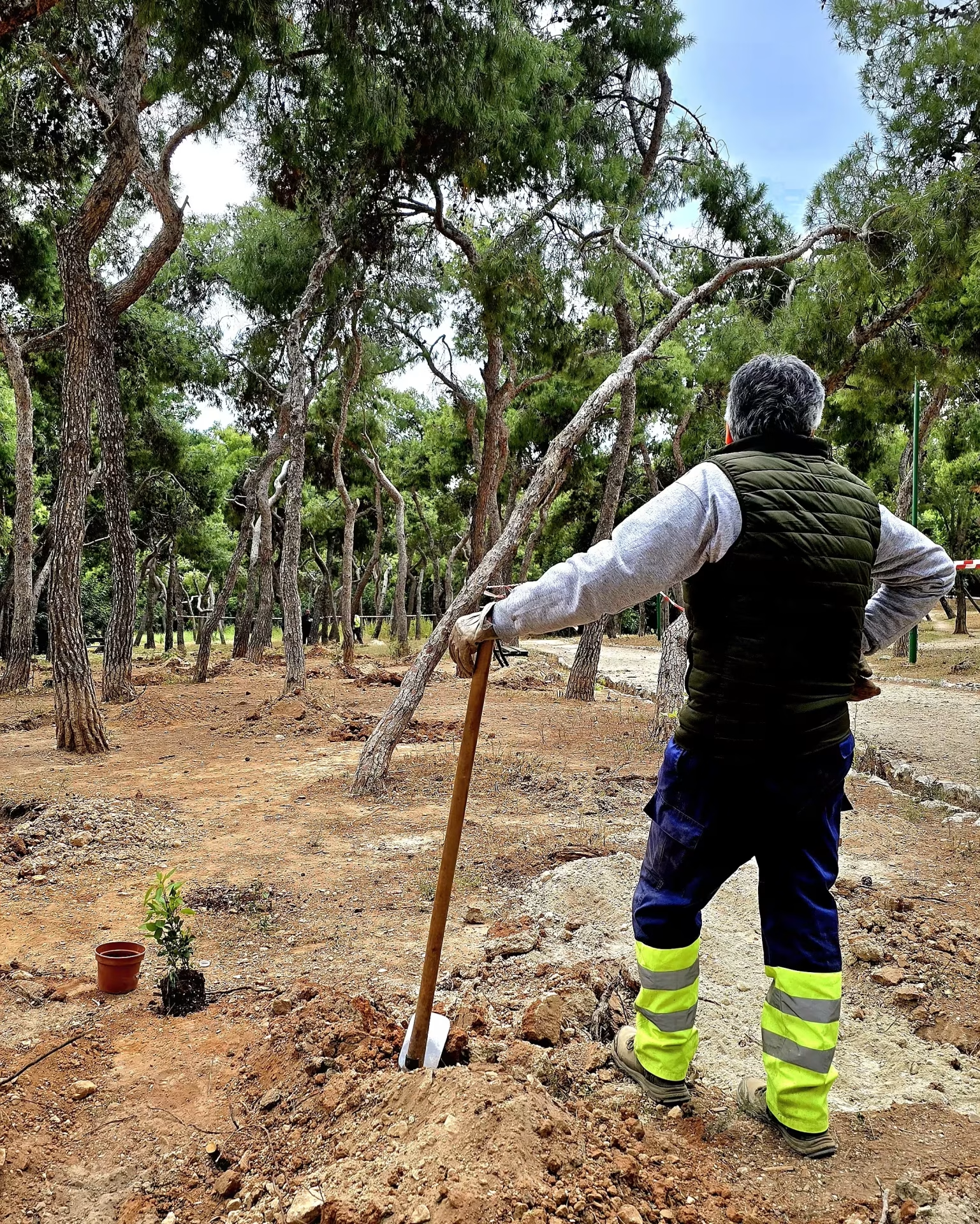
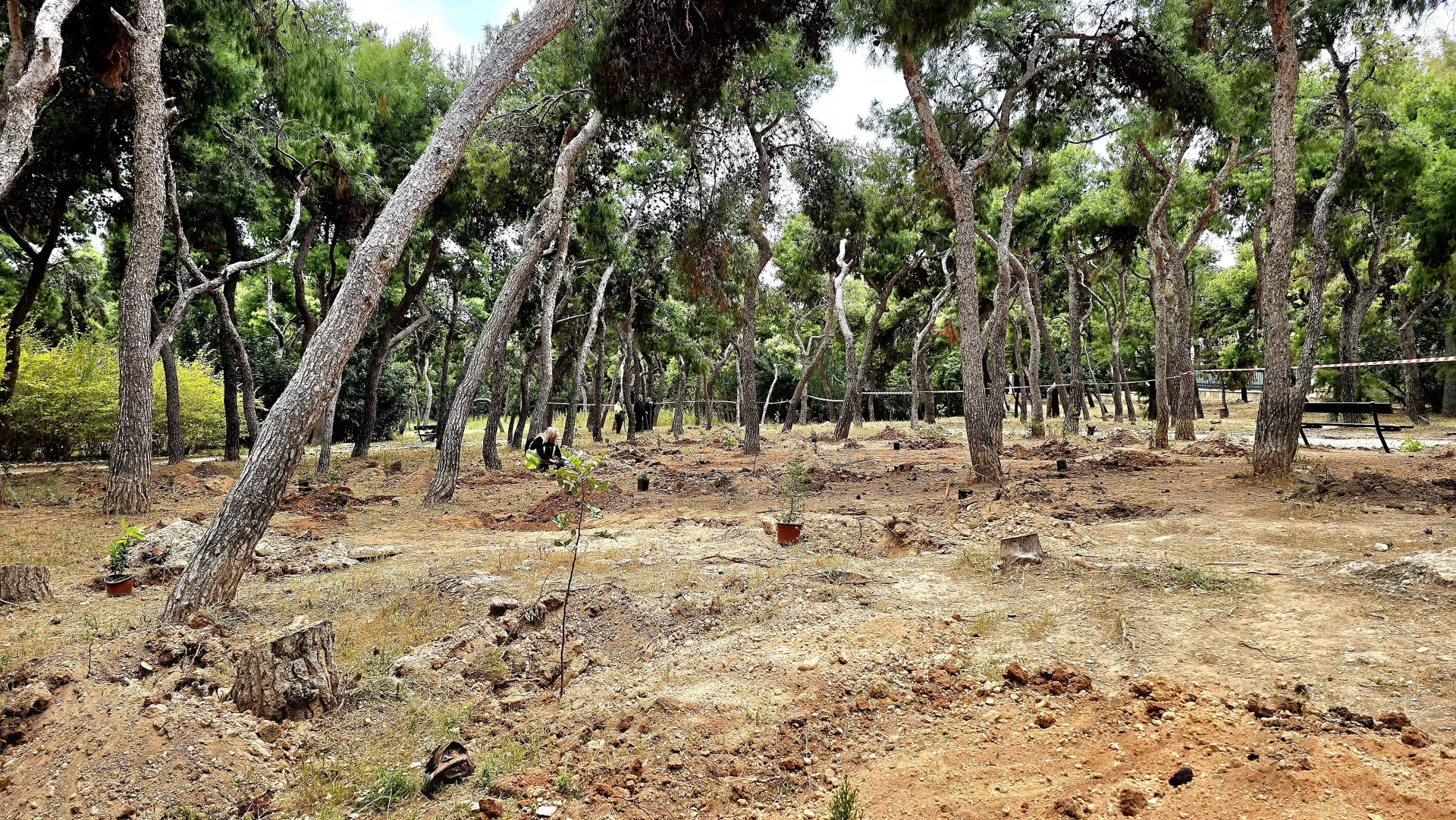
Already on the initiative of the Deputy Mayor for Green Affairs of the Municipality of Athens George Apostolopoulos, deforestation is taking place in the Evelpidon Grove, some small and large trees have been planted, while holes have been dug for the new plantings on Tuesday. At the same time, dried trees are being supported or removed.
The need for more greenery in the urban fabric is more urgent than ever. Public spaces are not a luxury – they are a prerequisite for quality of life, clean air, coolness, health and humane neighborhoods.
The Director of Greenery and Urban Fauna of the Municipality of Athens Dimitrios Tsagaropoulos compiled and gave us a complete report on the situation of Alsos and the planning of the Municipality of Athens for resolving its problems, so that the residents and friends of Alsos Evelpidon are informed.
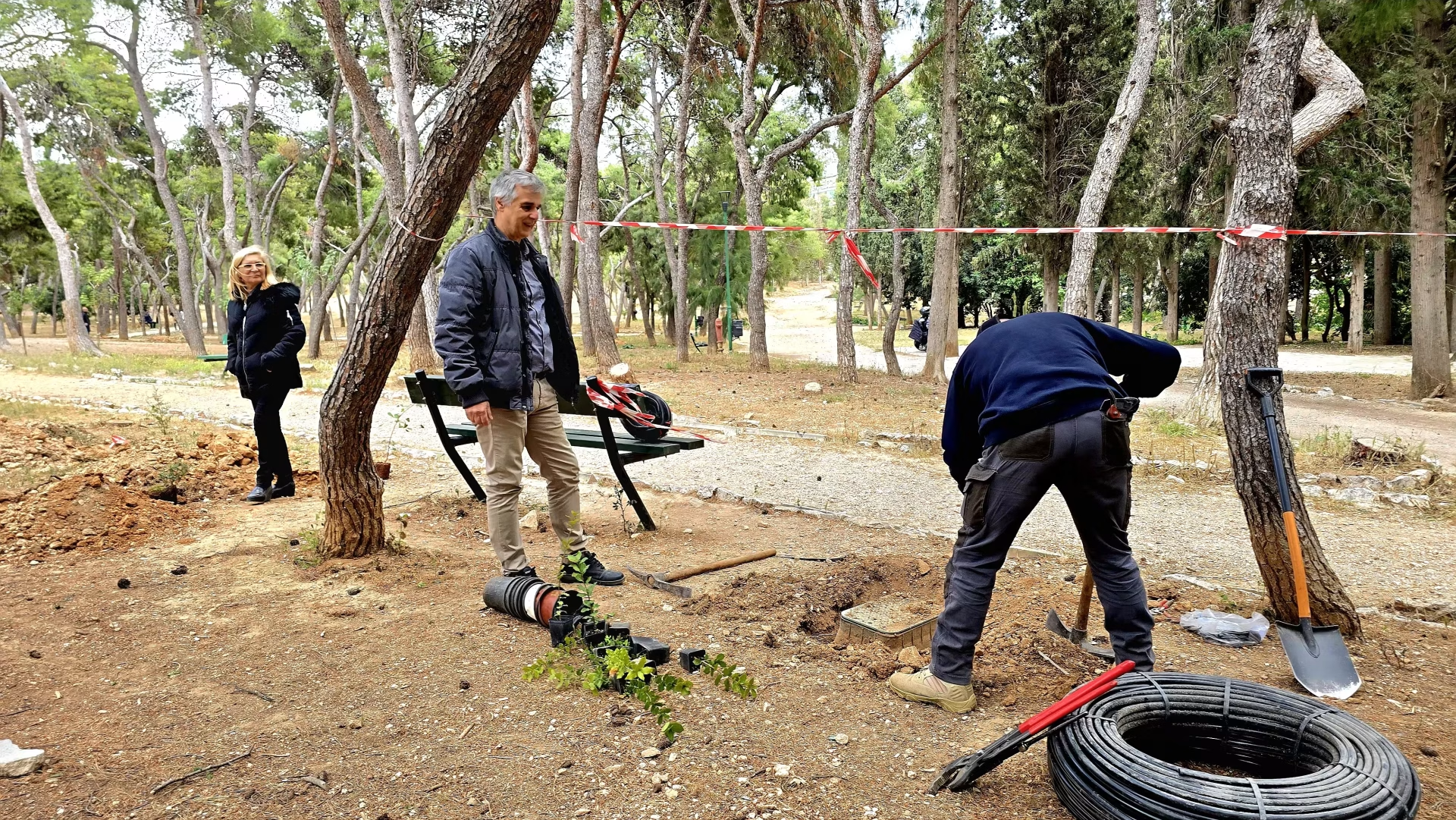
Cadet School Grove
Report by the Director of Greenery and Urban Fauna of the Municipality of Athens, Dimitrios Tsagaropoulos.
The Evelpidon School Grove is located within the administrative boundaries of the 6th Municipal Community and occupies an area of 82,224.06 sq m. and is characterized by the presence of the Aleppo Pine (Pinus halepensis). The pine is a characteristic species of the Attic landscape and is particularly resistant to drought and the climatic conditions of the area. This vegetation is not natural in its entirety but comes from plantings, which were developed in an irregular arrangement of same-aged stems, aged 30-50 years.
Disasters from Snow and Drought
During the years 2021-2022, the adverse weather conditions of the winter season and the snowfalls that hit Attica resulted in several disasters to the vegetation of Athens. Specifically, in the Evelpidon School Grove, a large number of trees with broken branches were recorded and many pine trunks were removed as they had undergone natural fall (uprooting), because the specific gravity of the water exceeded the usual limits to which the trees of the Athens hills are adapted (in 2022, approximately 70 pine trees fell in the Evelpidon School Grove). This fact, combined with the prolonged drought of the summer months, for a number of years, has greatly disrupted the balance of the ecosystem, resulting in a reduction in the vitality of existing trees (see cypresses Cupressus sempervirens) and the development of spot thinnings at a greater rate than in previous decades.
Trails and Erosion
Additionally, the grove has a developed network of paths for access to its individual sections. The majority of the paths are paved with soil and have stone curbs, while there are occasional locations where the paving material is concrete or paving slabs.
Visually, the image of the corridors is adequate and largely follows the original design of the grove, as shown in the historical background of the year 1945. In the central and western part, the corridors are all earthen with sufficient branches, so that all the subsections are connected, but without the existence of a curb, which clearly delimits the network but also prevents the transport of debris from the adjacent vegetation surfaces. The absence of a curb, especially in sections with increased slopes (northern - northeastern part of the grove), results in the washing out of the surface soil, the gradual reduction of the passability within the network of paths and its further surface erosion.
10-Year Management Plan for the Everpidon Grove
As can be seen from the above, and in combination with the necessary maintenance actions of the urban equipment and infrastructure inside the grove (trash bins, wooden seating areas, fencing, stone house, etc.), it is the obligation of the entity that owns the grove to proceed with the preparation of the 10-year management plan for the grove, that is, the drafting of the Management Study.
The Municipality of Athens, in the past and for a number of years, had repeatedly proceeded with procedures for the receipt of the Cadet School Grove, with the aim of subsequently taking the necessary measures to protect the grove and to proceed with the drafting of implementation studies to prevent its degradation. The ownership of the grove belongs to the Ministry of National Heritage and Culture, and specifically to the Athens Forests Directorate.
Decisions of Ministries and the Council of State for the Everpidon Grove
- Decision 53310/3523/18-12-1970 Ministry of Agriculture – handover of the grove to the Municipality of Athens.
- Joint Ministerial Decree 77250/3866/10-7-1991 of the Ministers of Interior, Finance and Agriculture.
- No. 4570/1996 Decision of the Council of State, annulling the Joint Ministerial Decree.
- Joint Ministerial Decree 95202/9572/PE/10-2-1997 of the Ministers of Interior, Public Administration and Decentralization, Finance and Agriculture.
- No. 714/2001 Decision of the Council of State, annulling the Joint Ministerial Decree.
- Joint Ministerial Decree 91876/888/29-10-2001 of the Ministers of the Interior, Public Administration and Decentralization, Finance and Agriculture.
- No. 3142/2006 Decision of the Council of State, annulling the Joint Ministerial Decree.
- Approval 2019/28-07-2006 of the study of the Municipality of Athens entitled "Renovation of the Evelpidon School Grove" by the Region of Attica.
- No. 166/2008 Decision of the Council of State, annulling the approval of the study.
- Joint Ministerial Decision 93215/565/21-05-2007 of the Ministers of the Interior-Public Administration and Decentralization, Economy and Finance, Rural Development and Food.
- No. 677/2010 Decisions of the Council of State, annulment of the aforementioned Joint Ministerial Decision.
Management Study
History of actions and management study of the Cadet School Grove
The management study was submitted to the Forestry Directorate with the ΑΠ 121778/25-04-2023 for approval. This was followed by suggestions from the Athens Forestry Directorate regarding the content of the Management Study (ΑΠ 335132/30-06-2023) and re-submission of the study for approval by the Greening Directorate (ΑΠ 333194/28-11-2023).
This was followed by an amendment to the Government Gazette 2828/Β'/2015 with the Ministerial Decision No. ΙΠΕΝ/ΜΠΟΔ/63943/4383, which resulted in the return of the Management Study to the Directorate of Greenery (ΑΠ 466067/20-09-2024 Directorate of Forests) and its resubmission for approval with the Decision No. ΑΠ 27201/30-01-2025. The Directorate of Greenery is awaiting the approval of the Management Study of the Cadet School Grove by the Athens Directorate of Forests.
Management Study Content
The purpose of the Management Study is to develop a 10-year green space management plan, which identifies potential projects, works and activities, which are approved during the project-specific study. The proposed management plan is based on the analysis and evaluation of the prevailing conditions and subsequently on the formulation of specific proposals for the promotion (to the maximum extent possible) of the vegetation and the executive purposes of the Cadet School Grove as an urban green space.
The aim of the study is to take the necessary management measures at an environmental level, which in their entirety will aim at the sustainability of the grove and the maximum provision of its beneficial effects on the society as a whole but also on the natural landscape of the city of Athens. The first part of the Management Study includes all the elements/characteristics of the current state of the green space, the second part of the study follows the proposed interventions/actions/actions/projects and works for the sustainable management and protection of the grove.
In the case of the Evelpidon School Grove, which is located in the center of Athens, with high traffic due to the direct connection to the fixed-track network and its proximity to several points of interest, as well as due to the general layout inside the grove, which is designed to be functional, providing access to all areas, works were proposed to improve the vegetation and infrastructure, but without expanding land uses or changing their destination. In addition, the existing condition of the grove, the vegetation and the infrastructure that are designed, contribute to creating an image of a simulation of a natural ecosystem. This naturalness of the ecosystem can be immediately perceived after comparison with the Pedion Park of Areos, which is characterized by horticultural configurations and a different landscape architecture, which could be characterized as anthropocentric. Taking into account all the individual characteristics of the grove, the following were proposed:
- Electrical-mechanical study for lighting, which will focus on the maintenance of the existing network (76 lampposts) and on investigating the placement of solar lighting poles in sections that are functional and reduce the energy requirements of the space, while simultaneously reducing the phenomenon of light pollution for the flora and fauna of the grove.
- Special architectural study which will include works to improve the aesthetics of the grove, restoration and enhancement of existing formations, installation of new infrastructure by introducing new elements that will enhance the existing ones, more specifically:
- Maintenance, restoration and improvement of the trail network. Change of the paving materials of the trail network, where deemed feasible, and utilization of stabilized water-permeable materials, with the aim of comprehensive anti-corrosion protection of the grove.
- Investigation of the method and ways of smoothly dispersing rainwater within the grove (open or closed channels/kennels, rain gardens, etc.), and then concentrating it in a central part of the grove, for its subsequent utilization. The methods must belong to the Nature-based Solutions category.
- Maintenance of the fence along its entire length twice in the reference period (10 years), partially or completely, immediate replacement of problematic sections.
Installation of a new, unified form for all or part of the groves, if this is deemed necessary and at the same time functional.
- Placement of structures-urban equipment, which concerns the fauna that the grove hosts, either in one section or with random dispersion.
- Maintenance of an existing stone building for the storage of consumables and tools of the employees of the Green Department.
- Maintenance – cleaning of existing stone retaining walls.
- Formation and enhancement of an existing plateau in the Northeastern part of the grove, which has a panoramic view with a Northwestern orientation. Enhancement of the sections with outcrops of the parent rock and supplementation with regional plantings of chasmophytic vegetation of suitable species.
- Provision for the establishment and operation of a fenced dog park in accordance with article 30 of Law 4830/2021 (Government Gazette 169/A/18-9-2021).
- Utilization of the building in the NE part of the grove (former forest guardhouse) in collaboration with the Athens Forestry Directorate.
- Erosion reduction works, repair where required of stone curbs to retain the soil mantle and creation of retaining walls to retain the transported materials in two sections where soil leaching was observed, similar to the existing ones, and friendly to the ecosystem.
- Recording and maintenance of the existing irrigation network.
- Maintenance of the irrigation network and restoration of damage. Maintenance and re-operation of the borehole. Investigation of the necessity of constructing new taps with appropriate dispersion within the grove.
- As the area is at risk of soil erosion, in the northern part of the grove and at the landscaped entrances from the buildings of the Athens Court of First Instance and Protomaya Square, it is planned to repair the stone curbs and stone retaining walls where necessary, to retain the soil mantle and avoid soil erosion. Also, construction of similar stone walls in the parts of the grove where deemed necessary with the aim of retaining the soil.
- Fire Protection Study, which will include the installation of hydrants and a fire protection system for the area. As part of the fire protection, care should be taken for the maintenance and re-operation of the tank that exists within the grove (a fixed concrete structure).
- Special horticultural study which will include the following:
- Mapping of vegetation to be removed (areas with dangerous - infected - crooked trees).
- Management plan for the reduction of the evergreen.
- New plantings to enrich/replace vegetation where needed and to increase biodiversity (mixing of endemic species and use of broadleaf).
- Cleaning, thinning, pruning and removal of existing vegetation to protect the natural ecosystem.
- Management of existing trees, through taking measures to combat diseases and taking measures for the phytosanitary condition of the trees.
- Enrichment of the soil with organic additives and application of fertilizers where deemed necessary for new plantings.
- Irrigation of new plantings and areas deemed necessary.
- Proposals for highlighting the sections with outcrops of the parent rock in the Northeastern part of the grove and supplementing them with regional plantings of chasmophytic vegetation of suitable species. In addition, regarding the vegetation of the grove, the following are also proposed:
- Removal of dead trees.
An important action for the sustainable development of the vegetation of the grove is to ensure the health of the individuals that grow within it. This means that both dead standing trees and those affected by diseases/fungi/insects must be removed (or in the case of combating the disease, the necessary actions must be taken). Because the grove is heavily populated with the evergreen, which is essentially a parasitic-invasive species, a management plan will be drawn up that will monitor the spread of the species with the aim of its complete removal.
- Vegetation protection works
For the existing vegetation, it is important to periodically carry out interventions to manage the plant mass, both of a cultural nature (pruning and thinning), and clearing operations, after a study. It is particularly crucial that these operations are carried out by specialized personnel and at specific time intervals (early spring) so as to provide the necessary space and time for the sustainable development of vegetation individuals and not to hinder the flowering and growth of plants. This clearing will be carried out at the beginning of the summer season for fire safety reasons.
In addition, plant protection actions against all phytopathogenic organisms, mainly insects and fungi, are included, through the application of sprays and the use of biological preparations that are environmentally friendly and safe for public health.
- Enrichment of the grove's vegetation
Among the factors that determine the success of plantings are soil and water. The planting sites will be enriched with topsoil and before planting, irrigation will be ensured. It is proposed to prepare a horticultural study that will contain a specific planting plan, the locations and the types of planting.
Basic principles that must be taken into account in each of the above fields of vegetation management include, among others, the following:
- Use plant species whose biological requirements are the same as the specific bioclimatic conditions.
- The color, texture, and form of the vegetation to be installed should not differ significantly from that of the surrounding area.
III. Plant species should be selected based mainly on their resistance to the urban environment, etc.
The Aleppo pine population that characterizes the grove is old and has numerous problems (disease attacks, superficial root system and poor support, high proportion of dry vegetation, etc.). The enrichment of the vegetation must contain broadleaves in organized clusters in the gaps resulting from the excessive thinning of the Aleppo pine. The species that will be selected for planting are considered appropriate to serve the aesthetic upgrade but also the resistance to the conditions of the urban landscape, in order to ensure their development as well as their integration into the natural vegetation of the wider area.
Parks and groves cover a variety of activities depending on their size. At the same time, their internal configuration must be designed in such a way as to protect and highlight their natural character. The current legal framework of permitted uses within public green spaces does not allow for the change of use or destination of public green spaces within city plans, which are covered by forest vegetation that has been created naturally or artificially.
Benefits of the Everpidon Grove
The Evelpidon School Grove, as a green lung within a dense urban fabric, offers benefits:
- Environmental (reduction of air pollution and noise pollution, contribution to addressing the urban heat island phenomenon and flooding phenomena, etc.)
- Social (functioning as a place for recreation, various activities and social gatherings, maintaining physical and mental health, etc.), and
- Economic (increased economic activity in neighboring areas, etc.). The future of the Evelpidon School Grove is defined by its need to protect and maximize these benefits, by applying the principles of viability and sustainability, both in its design and in its management actions. In this context, the Evelpidon School Grove, like any high-quality green space in Athens, contributes to the sustainability and resilience of the city and at the same time to addressing the negative impacts of climate change.
In accordance with the above, the studies proposed to be prepared by the Management Study for the Cadet School Grove and which will receive the necessary approvals for their implementation should be governed, among others, by the following principles:
- To not affect and restore where necessary both the diversity of the plantings, as well as the accessibility and reachability of the facilities, as these have largely shaped the physiognomy and character of the Grove, so as to highlight its existing form.
- Anthropogenic interventions of various forms (environmental, cultural, recreational, etc.) should not cause damage to the formations of the natural environment.
DIRECTOR OF GREEN & URBAN WILDLIFE OF THE MUNICIPALITY OF ATHENS
DIMITRIOS TSAGKAROPOULOS


Leave a comment: